
The missing ingredient is money
Artificial intelligence is rapidly moving from answering questions to taking actions. Yet there is an important difference between an AI system that tells a treasurer what to do and one that can move the company’s money. Moody’s Ratings highlighted that distinction in July 2026, arguing that the combination of agentic AI and digital cash could turn software from a decision-support tool into a delegated economic actor. Stablecoins, tokenised deposits and deposit tokens can give an authorised agent access to value, allowing it to initiate payments, rebalance cash, post collateral and settle obligations within defined rules. This is potentially a much larger economic development than another improvement in online banking. An AI agent can operate continuously, examine thousands of variables and interact directly with other software. Give it machine-readable money and the gap between decision and execution begins to disappear. The agent no longer needs to recommend that a human makes a payment tomorrow morning. Subject to its mandate, it can potentially make the payment when the agreed conditions are satisfied.
Why digital cash fits machines
Traditional payments were designed primarily around people and institutions. They include bank opening hours, cut-off times, approval screens and processes that assume a human will eventually press a button. Digital cash can work differently. Moody’s notes that stablecoins and tokenised bank money can remain continuously available and interact directly with wallets, tokenised assets and smart contracts. This does not mean agentic AI requires blockchain. Real-time payment systems and bank APIs can also support automation. The difference is that programmable digital money can combine the asset, payment instruction and settlement logic in a machine-readable environment. Coinbase’s x402 provides a practical example. The protocol uses the web’s HTTP 402 “payment required” status so software can discover a service, receive a price and pay for it using stablecoins. In August 2026, Amazon Bedrock AgentCore Payments went generally available with Coinbase infrastructure, enabling agents hosted on AWS to discover and pay for services autonomously. On 22 September, Coinbase went further, adding equities and x402 payments to Coinbase for Agents, allowing an authorised agent to pay for data or models and use that information within a trading workflow. The important point is not cryptocurrency speculation. It is that software is beginning to acquire a payment mechanism designed for software.
From treasury assistant to treasury actor
Corporate treasury illustrates the potential. An agent could monitor cash balances, foreign-exchange rates, interest rates, collateral requirements and payment obligations across several banks and jurisdictions. Instead of merely producing a dashboard, it could decide which account should fund a payment, which rail offers the appropriate combination of cost and speed and when liquidity should move. JP Morgan’s 2026 Treasury 2.0 research describes a world in which treasury infrastructure becomes increasingly agent-native and multi-rail. That matters because companies may simultaneously have access to conventional bank payments, instant-payment systems, stablecoins and tokenised deposits. Humans are poorly suited to continuously comparing every route. Software is not. The same logic extends into capital markets. An agent could identify a margin call, determine which eligible collateral is cheapest to deliver, obtain the necessary authorisation and initiate settlement. In trade finance, it could compare a purchase order, invoice and shipping information, identify whether contractual conditions have been met and request payment. These processes already contain automation. Agentic AI adds something different: the ability to interpret changing circumstances that were not completely anticipated when the workflow was written.
Probabilistic intelligence cannot mean probabilistic money
This is where the architecture becomes critical. Large language models are probabilistic. Payments cannot be. The IMF’s 2026 work on agentic payments separates the process into intent, authorisation and settlement. AI can interpret what somebody wants and decide how a task might be completed. A control layer can then test identity, mandate, spending limits, compliance and other deterministic conditions. Only after those checks should a settlement layer move the money. That separation deserves more attention. A highly capable agent may conclude that paying £250,000 to a supplier is economically sensible. It should not follow that the agent automatically has authority to transfer £250,000. Intelligence and authority are different things.
Digital cash could give agentic AI controlled access to value
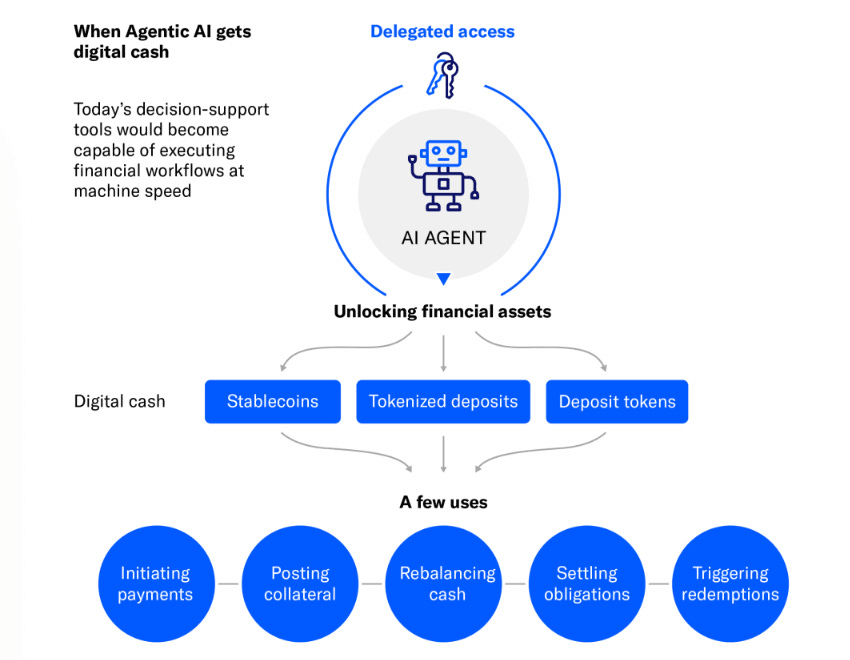
Source: Moody’s ratings
This suggests a basic design principle for agentic finance: the AI may propose or orchestrate, but deterministic controls should decide whether value is permitted to move. For higher-risk transactions, a human approval requirement can remain part of that control layer.
The risk surface grows with the capability
Giving software access to money inevitably changes the consequences of failure. A chatbot hallucination may produce a bad paragraph. A financial agent acting on a hallucination, manipulated instruction or compromised API can produce an actual transfer. Moody’s identifies risks including prompt injection, malicious invoices, credential theft, compromised data feeds, excessive wallet permissions and uncertainty over whether an instruction was genuinely authorised. These are not simply cyber-security issues. Once an agent controls value, a technology failure can become a liquidity, legal or credit event. There is also a less obvious systemic risk. Imagine thousands of treasury agents using similar models and responding to the same market signal. Each might rationally decide to move cash to a safer institution, redeem a stablecoin, sell an asset or demand additional collateral. Individually, every decision could make sense. Collectively, machine-speed execution could accelerate a run or amplify market stress. The efficiency of the individual agent could therefore increase fragility across the system. Financial markets have encountered versions of this problem with algorithmic trading. Agentic finance potentially extends it into treasury, payments, collateral and liquidity management.
Agentic AI financial workflows will need counter measures against a new breed of risks
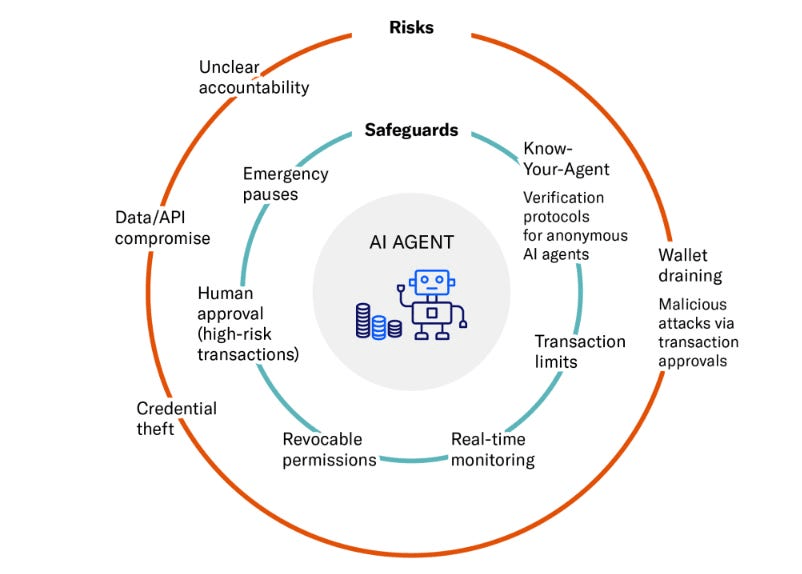
Source: Moody’s ratings
Who authorised the machine?
The most important question may therefore be neither which model an agent uses nor which blockchain carries the payment. It may be: who gave the agent authority? A financial institution dealing with an autonomous agent needs to know more than the identity of the human or company behind it. It may need to establish which agent is acting, who controls it, what mandate it has, how much it can spend, which counterparties it may engage with and whether its authority remains valid at the moment of execution. This is the emerging case for ‘know your agent’, or KYA. Visa has already introduced agent identity and scoring capabilities whilst the IMF identifies agent authentication, verifiable credentials and programmable spending controls as important components of agentic-payment architecture. KYA should not replace KYC. It adds another layer. A bank may know its corporate customer perfectly well whilst still needing to determine whether a particular piece of software is authorised to instruct a £1 million payment on that customer’s behalf. The audit trail becomes equally important. If Agent A instructs Agent B, which calls a payment service that executes a smart contract, a dispute may require reconstruction of the entire chain: identity, mandate, instruction, acceptance, control checks and execution.
Liability may become part of payment infrastructure
That chain leads to a difficult commercial question: who is responsible when agents transact with agents? The answer will depend on contracts, applicable law, the nature of the transaction and the controls operated by each participant. It is nevertheless useful to distinguish two responsibilities. The party deploying an outbound agent needs to establish what that agent is authorised to request. The party operating the receiving system needs to decide what instructions it is prepared to accept and execute. That distinction could become machine-readable. Instead of treating authorisation as a box checked when an agent is first created, a transaction could carry evidence of the agent’s identity and mandate, whilst the receiving system independently applies its own limits and controls. In other words, future payment infrastructure may need to transmit not only value but evidence of authority.
What this means for business and the wider economy
For businesses, the upside is considerable. Treasury could become more continuous, working capital could be used more efficiently, cross-border payments could become faster and software could purchase data, computing power and other digital services without human checkout processes. Smaller transactions that are uneconomic under conventional payment structures may become commercially viable. For banks and payment companies, however, value may migrate. If AI agents choose dynamically between cards, bank transfers, stablecoins and tokenised deposits, the winning infrastructure may be the layer that authenticates the agent, interprets its mandate, checks compliance and routes the transaction rather than the rail that physically carries the money.
For regulators, speed changes the problem. Controls designed to detect a questionable transaction after it occurs become less useful when thousands of autonomous transactions can occur before a human notices. Identity, permissions, transaction limits, real-time monitoring, revocable authority, emergency pause mechanisms and human intervention for exceptional transactions become part of financial stability rather than merely good IT practice. The economic prize is therefore not simply autonomous payments. It is controlled autonomy.
The wallet is only the beginning
Moody’s central observation is persuasive: agentic AI becomes materially more consequential when it can move value rather than merely analyse information. But giving an AI agent a digital wallet is the easy part. The harder task is building the trust architecture around it. Markets will need to know who controls the agent, what it is permitted to do, how counterparties verify that authority, which controls stand between probabilistic reasoning and deterministic settlement and who carries responsibility when something goes wrong. Stablecoins and tokenised deposits may provide the money that machines can use. AI provides the intelligence that decides when and how to use it. The infrastructure connecting the two may ultimately determine whether agentic finance becomes a productivity revolution or simply a faster way of making expensive mistakes.
The defining question for the next stage of digital finance may therefore be surprisingly simple: “Before we give an AI agent money, can we prove who authorised it to spend?”
This article first appeared in Digital Bytes (3rd of November, 2026), a weekly newsletter by Jonny Fry of Team Blockchain.
How can a stablecoin failure affect the wider financial system?