
RWA tokenisation is the process of converting tangible assets existing outside the digital spectrum (including vast classes such as real estate, government bonds, private credit and fine art) into tradeable digital tokens on a public or private blockchain. Meantime, financial markets are pivoting due to the fact that real-world asset (RWA) tokenisation has shifted from a theoretical concept to a scalable reality, establishing itself as one of the strongest narratives in global finance. For institutional finance, this innovation fundamentally validates blockchain infrastructure as a credible platform and the commitment from traditional finance leaders underscores the magnitude of this structural shift. Larry Fink, CEO of BlackRock, has previously suggested that tokenisation could potentially have a greater impact than artificial intelligence and this sentiment is further supported by industry forecasts, with Standard Chartered projecting that the total addressable market for tokenised assets could reach a staggering £24 trillion ($30 trillion) by 2034. This institutional confidence provides crucial legal certainty and attracts the large pools of institutional money necessary for sector maturity.
Tokenisation vs. traditional asset management comparison
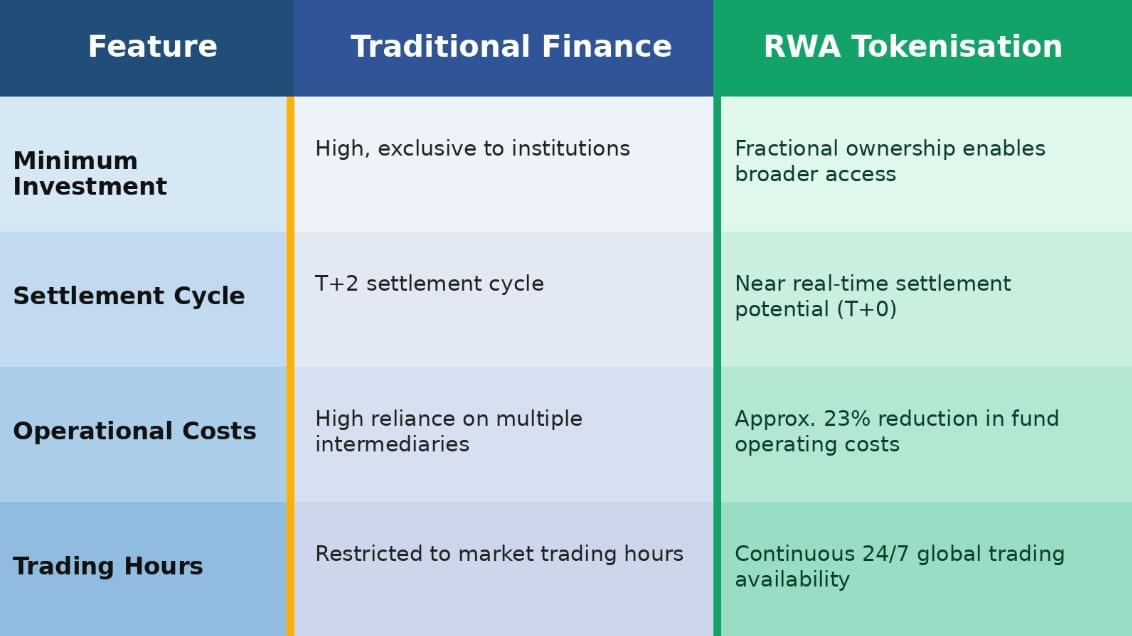
Source: investax, rwa.io, xbto, wisewaytec
The tokenisation of a real-world asset requires a structured, multi-step process that meticulously links off-chain legal rights to on-chain digital tokens. The initial steps involve asset identification and defining the legal rights associated with the asset. This is followed by the crucial phase of legal structuring, which typically requires establishing an investment vehicle, such as a special purpose vehicle (SPV), to legally hold the underlying asset and define the custodianship arrangement. Once the legal structure is secure, digital tokens are minted via smart contracts which represent ownership or a fractional interest in the asset held by the SPV. The final integration step links these legal rights to the tokens themselves, allowing for digital transfer and management; this process necessitates a fusion of law and code. Tokenisation does not eliminate the need for traditional legal systems - rather, it requires enforceable legal contracts that explicitly define the rights and obligations of token holders, particularly regarding ownership and transfer mechanisms. Since the asset remains in the physical world, a blockchain oracle (a secure service that provides external data) is essential to feed real-world data such as the asset’s legal status or value to the smart contract, ensuring the digital transfer has proper legal effect in the relevant jurisdiction.
The reliance on smart contracts, therefore, dictates that the legal structure and traditional law serve as the foundational reality, with the code acting as an automated executor of pre-existing legal terms. For tokenised securities, compliance demands sophisticated mechanisms. Unlike permissionless standards such as ERC-20, permissioned tokens, exemplified by the ERC-3643 standard, are vital for RWA adoption. These standards ensure that only qualified users who meet regulatory conditions, such as know your customer (KYC) and anti-money laundering (AML) requirements, can hold or trade the tokenised security. Whilst crucial for regulatory acceptance and attracting institutional capital, this necessity for strict compliance and permissioning inherently introduces centralised controls such as whitelisting and custodial concentration. Sacrificing absolute decentralisation for regulatory certainty, this trade-off is the essential cost of entry for large-scale institutional adoption.
The core value proposition of tokenisation rests on its ability to transform traditionally illiquid assets, such as real estate or private equity, into tradeable, dynamic financial instruments. By enabling fractional ownership, tokenisation allows large assets to be divided into affordable ‘slices’, thereby lowering the minimum investment threshold. This process effectively democratises access, allowing everyday investors to participate in high-value asset classes previously reserved for institutional players. Beyond accessibility, tokenisation delivers significant gains in operational efficiency by streamlining processes and reducing reliance on numerous traditional intermediaries, including custodians, brokers and clearing houses. Transactions settle in minutes, offering the potential for near real-time, T+0 settlement. This efficiency drastically reduces counterparty risk and frees up capital that would otherwise be locked in the traditional T+2 settlement cycles. For asset managers, the shift to distributed ledger technology (DLT) is not merely technical; it offers a compelling economic incentive with surveys projecting average savings of 23% in fund operating costs.
However, despite the clear technological potential for T+0 settlement and 24/7 global trading, the RWA market currently exhibits a market maturity deficit. Data shows that many RWA tokens suffer from low trading volumes, limited secondary trading activity and long holding periods. This demonstrates that, whilst the technology exists, structural barriers including the scarcity of regulated trading venues and persistent custodial concentration are currently preventing the full liquidity potential from being realised. However, the projected 23% savings in operational costs represent an enhanced profitability factor that is critically important to major financial institutions, arguably serving as the primary commercial driver for infrastructure migration. The contrast between tokenisation and conventional asset management, as shown above, highlights the systemic advantage of the new paradigm. Certainly, the tokenised RWA market has diversified but its growth in 2025 has been heavily concentrated in specific asset classes. Tokenised US Treasury bills (T-Bills) have led the growth, surging from approximately £3.1 billion ($3.91 billion) to nearly £6.9 billion ($8.68 billion) over the year. In addition, these assets offering global investors secure, USD-denominated yield, often in the 4-8% APY range, accessible 24 hours a day. Key institutional players, including Franklin Templeton and Ondo Finance, are instrumental in issuing these tokenised yield assets. The rapid adoption of T-Bills is driven by macro-economic factors; rising global interest rates made these traditional, low-risk assets immensely attractive, and tokenisation has simply provided a superior, highly efficient 24/7 global mechanism to access that stable yield.
Interestingly, private credit instruments remain the largest component of the RWA sector despite the focus on T-Bills. Private credit, which includes tokenised corporate debt and invoices, dominates the market with a 58% share, accounting for roughly £11.2 billion ($14 billion) in 2025. Platforms such as Centrifuge are active in tokenising assets like invoices. The dominance of private credit instruments demonstrates that the highest-value, immediate application of tokenisation is addressing the chronic illiquidity and high friction inherent in private capital markets, functioning primarily as an efficient B2B enterprise finance solution. Meanwhile, real estate remains a flagship use case for tokenisation, enabling fractional ownership and programmable compliance. Examples include BlocHome’s use of the T-REX platform and BrickMark’s notable token-based acquisition of a commercial building. Beyond these major categories, the ecosystem is expanding to encompass private equity funds (such as TAGSPACE) and commodities such as gold (represented by PAX Gold).
RWA market dynamics: growth and institutional leadership
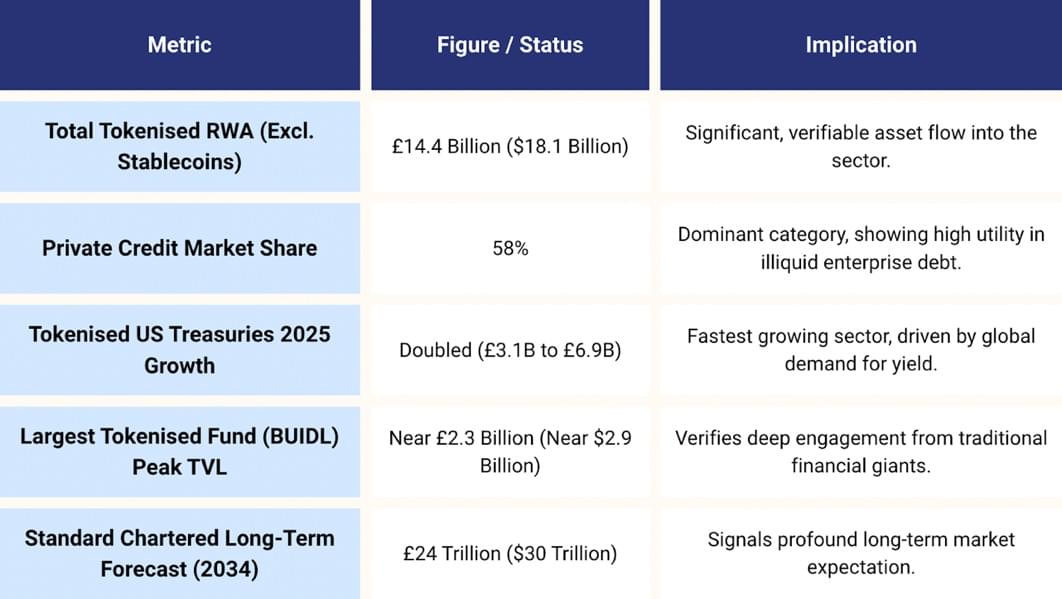
The maturation of the RWA sector has been directly driven by major financial institutions, including BlackRock, JPMorgan, Franklin Templeton and Apollo, which have moved beyond pilot programmes to production-scale deployment. BlackRock’s BUIDL fund, a tokenised Treasury fund, peaked near £2.3 billion ($2.9 billion), capturing over 40% of the tokenised Treasury market at its height. This institutional engagement confirms that the RWA market is evolving towards a “hybrid finance” model which uses blockchain efficiency while preserving traditional controls like per missioning and custody. Critically, RWA tokenisation is proving indispensable for the convergence of traditional finance (TradFi) with decentralised finance (DeFi). The stability and inherent value of RWAs make them superior collateral compared to volatile crypto assets. Hence, by backing loans with stable, real-world assets, the risk profile of DeFi lending is fundamentally improved therefore leading to potentially reduced collateralisation requirements and lower interest rates for borrowers. This stability attracts institutional lenders and is essential for the long-term systemic health of decentralised markets - MakerDAO’s RWA vault, valued at $1.78 billion, is a prime example of this utility. Furthermore, regulatory bodies are actively engaging with this trend. The US Commodity Futures Trading Commission (CFTC) approved a pilot programme in late 2025, allowing certain digital assets (including tokenised collateral) to be used in regulated derivatives markets. This regulatory validation marks a significant milestone in integrating tokenised assets into core financial market infrastructure.
Yet despite the exponential growth, RWA tokenisation continues to navigate a complex and fragmented regulatory landscape. Jurisdictional complexity is a primary obstacle, with countries often adopting conflicting definitions of what a token represents: be it a security, a crypto-asset, or direct property ownership. This inconsistency creates substantial uncertainty for cross-border transactions and asset issuers. In Europe, the Markets in Crypto-Assets (MiCA) regulation offers a crucial step toward harmonisation and legal certainty. MiCA clarifies the classification of tokens within the EU: tokens that function as traditional financial instruments (shares, bonds) remain under existing frameworks (MiFID II) whilst those that reference real-world value but are not structured as securities, such as asset-referenced tokens (ARTs), fall under the new MiCA framework. This clear dual classification aims to provide necessary consumer protection and market integrity across member states. On the technical front, Ethereum remains the leading execution layer for regulated RWA issuance, holding over $4.9 billion in tokenised US Treasuries. However, Layer 2 solutions, alongside high-performance chains such as Solana and Polygon, are essential for addressing Ethereum’s high transaction fees and scalability constraints, offering cheaper and faster alternatives. The market’s reliance on multiple chains and layers creates an imperative for sophisticated cross-chain interoperability protocols. The ability to move RWAs seamlessly and compliantly between these different environments is a critical bottleneck that must be resolved to unlock future global efficiency. Whilst technological security threats - particularly smart contract vulnerabilities, demand continuous security audits and best practices - the off-chain legal structure provides an essential second line of defence. The foundational legal agreements, custodianship and SPVs provide recourse and clear ownership definition off-chain. This mitigates the risk inherent in the blockchain’s immutability, ensuring that, in the event of an on-chain technical failure, ownership rights are protected and validated externally.
So, looking ahead in 2026, the RWA tokenisation sector is projected to accelerate further, driven by sustained institutional inflows and increasing global regulatory clarity (particularly due to frameworks such as MiCA). Tokenisation offers a transformative improvement over traditional finance by delivering enhanced transparency, immutability, significantly lowered operational costs and greater global access to wealth-generating assets. Unsurprisingly, the ultimate path to realising the full, multi-trillion-pound potential of this market requires a co-ordinated effort. The industry must bridge the gap between technological potential and current market reality by solving the structural barriers to liquidity. This necessitates synchronised progress across legal recognition, technical interoperability and institutional market structure development. RWA tokenisation is not merely a niche application; it is the defining structural shift that is silently and profoundly rewiring global capital markets this decade.
This article first appeared in Digital Bytes (24th of March, 2026), a weekly newsletter by Jonny Fry of Team Blockchain.