
AI can act, but cannot bear responsibility
An AI agent may select a counterparty, negotiate terms, interact with a smart contract and authorise payment. Yet it is not generally recognised as a legal person, therefore its outputs need to be attributed to a human being or organisation. The UNCITRAL Model Law on Automated Contracting, adopted in 2024, supports contracts formed or performed through automated systems, including AI and machine-to-machine transactions. It establishes rules for attributing automated outputs and addressing unexpected outcomes without requiring the system to possess legal personality. And the emerging direction is clear: autonomous execution does not remove human or corporate accountability.
Rome’s architecture of delegated commerce
Source: London Digital Escrow
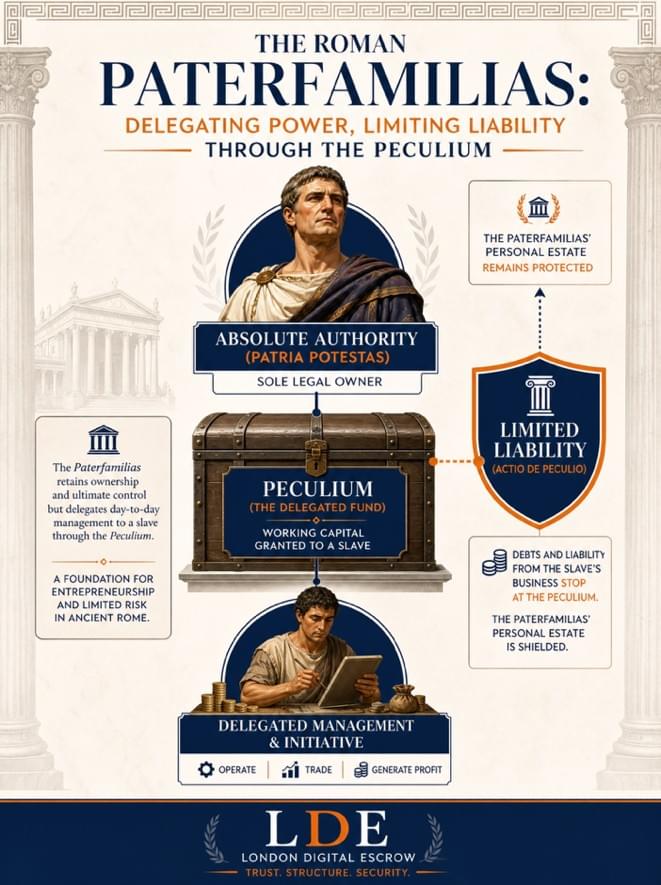
Roman law distinguished between people who were legally independent (“sui iuris”) and those subject to another’s authority (“alieni iuris”). The “paterfamilias” was the legally independent head of the household and principal holder of its property. He was not a ‘beneficial owner’ in the modern legal sense but can be compared cautiously with a principal asset owner, trustee, company or family office. Nevertheless, commerce required others to manage farms, ships and businesses and so the peculium was a fund placed under another person’s practical administration whilst remaining connected to the principal. The Roman jurist Gaius, Institutes, Book IV, sections 69 to 74, explained that liability depended on the authority granted; where the principal expressly ordered a transaction or appointed someone to operate a business or ship, liability could extend beyond the peculium. In other circumstances, recovery might be limited by reference to that fund. Justinian’s Institutes, Book IV, Title VII later restated this graduated approach and, in today’s climate, the resulting lesson is clear:
The greater the authority given to an AI agent, the greater the potential exposure of the principal behind it.
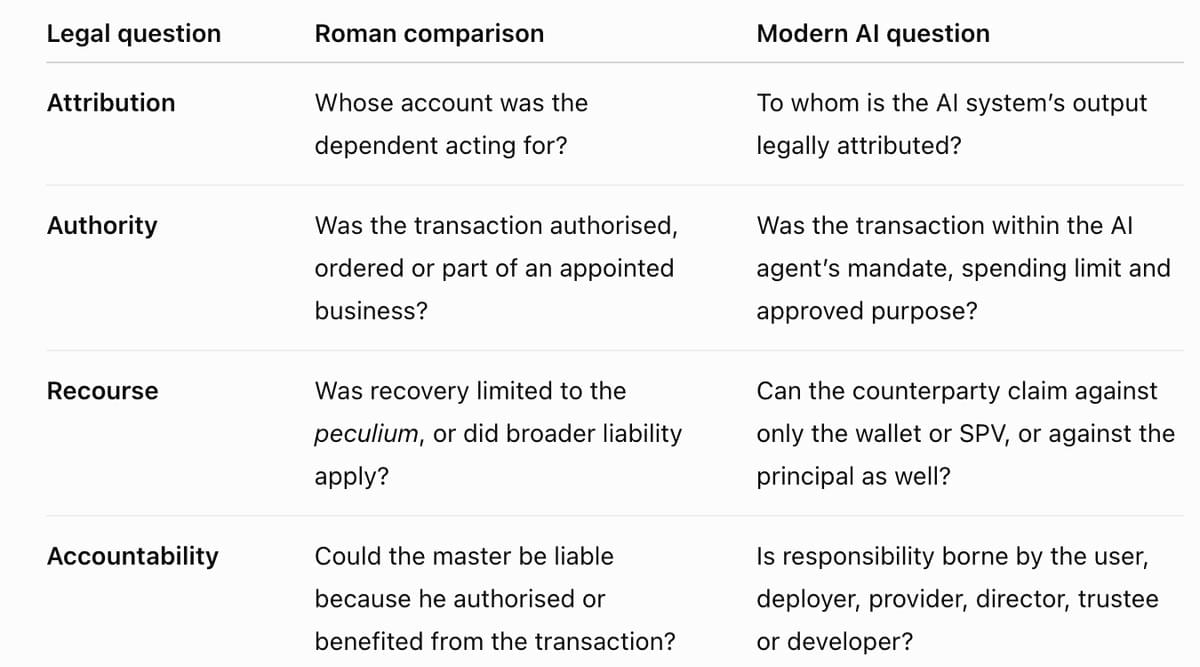
Four questions for AI transactions
Source: London Digital Escrow
In the case of wallets, a separate wallet does not itself determine authority or liability; asset segregation, attribution and recourse remain distinct questions.
What modern cases tell us
In the case of Quoine Pte Ltd v B2C2 Ltd, algorithms entered cryptocurrency trades after a platform failure activated a fallback price. The Singapore Court of Appeal treated the deterministic programs as mechanisms selected by their human operators, rather than inventing a separate legal mind for the software. The case suggests that using an automated system does not necessarily allow its deployer to disown a resulting contract, with these limits of unchecked automation having been exposed by US global financial services firm, Knight Capital. In 2012, faulty software sent more than four million erroneous orders in forty-five minutes, producing losses exceeding $460 million. Unsurprisingly, the SEC found inadequate safeguards, testing and supervisory controls and imposed a $12 million penalty. The lesson is that an AI peculium needs more than a capped wallet - it requires transaction limits, cumulative exposure controls, approved counterparties, price tolerances and an effective suspension mechanism. Another example can be seen in the case of Moffatt v Air Canada, where a tribunal held the airline responsible after its chatbot gave a customer inaccurate information about bereavement fares. These decisions are not universally binding but illustrates that a business cannot assume its AI interface is legally separate from the organisation deploying it. Meanwhile, the Ooki DAO litigation has provided a related warning - a US court held that a decentralised organisation could be sued as an unincorporated association and treated as a person under the Commodity Exchange Act. Similarly, the SEC’s 2017 DAO Report emphasised that regulatory treatment depends on economic reality, not technological terminology. A wallet, smart contract, DAO or SPV may segregate operations but it cannot automatically override securities law, sanctions obligations, consumer protection or fiduciary duties.
Why England and Wales could lead
The Law Commission has concluded that the law of England and Wales can generally support smart legal contracts without wholesale statutory reform. It also identified areas requiring further attention, including deeds, jurisdiction, interpretation and remedies. The Property (Digital Assets etc) Act 2025 has further confirmed that digital or electronic assets are not prevented from being objects of personal property rights merely because they fall outside the traditional categories of things in possession and things in action. That improves certainty over digital property but it does not determine who is responsible when an AI transfers it. The commercial opportunity is to combine existing contract, property, trust, company and financial-services law with a technically enforceable AI mandate.
Building a modern peculium protocol
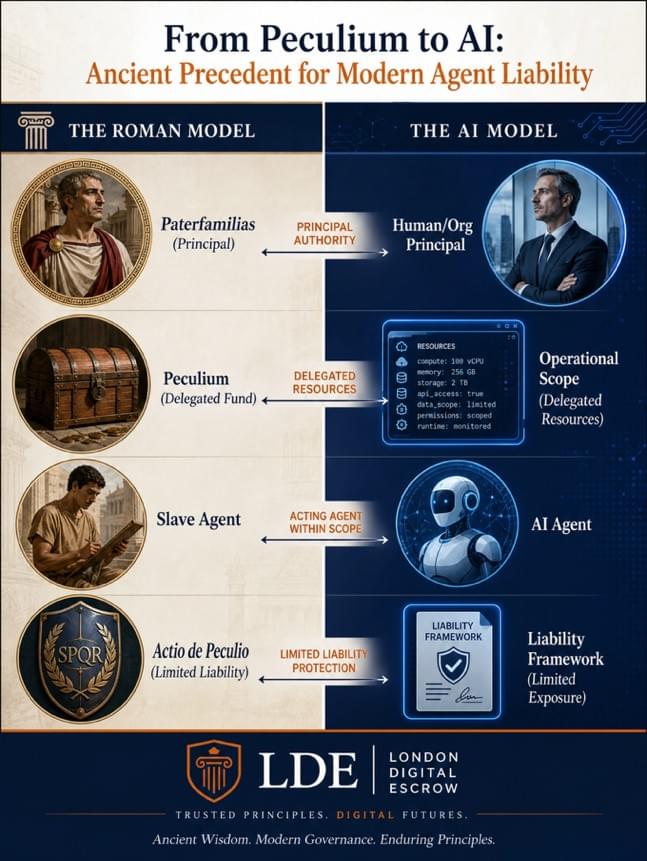
A modern AI peculium should be a legal and technical control framework where it would identify the principal and define the AI’s objectives, permitted assets, counterparties, jurisdictions and transaction types in a digitally signed mandate. Capital could be placed in a segregated wallet or account and smart-contract permissions would impose per-transaction and cumulative limits. Borrowing, pledging assets, using an unapproved protocol or exceeding a threshold would require human authorisation and instructions, data sources, decisions and transactions would be logged so the agent’s conduct could be reconstructed. Lawyers, trustees, directors, compliance officers or regulated custodians could validate authority, approve exceptional actions, preserve evidence and activate emergency suspension and insurance could then be priced against a measurable mandate and maximum exposure. Furthermore, ring-fencing would still have limits as it could not automatically exclude claims arising from fraud, negligence, sanctions breaches, regulatory violations, fiduciary misconduct or express authorisation by the principal. This all echoes Rome where liability depended not only on the assets allocated, but also on what was ordered, who benefited and how much authority had been granted.
Source: London Digital Escrow
The EU AI Act requires proportionate human oversight for high-risk systems, including the ability for authorised people to intervene or stop systems that are not operating as intended. The UK’s principles-based framework emphasises safety, transparency, accountability, governance and redress; both approaches point toward controlled autonomy rather than artificial personhood.
Autonomy without unaccountability
Roman law did not solve AI governance two thousand years in advance. It did, however, recognise that commerce could be delegated without leaving authority and liability undefined. AI agents do not need fictional personhood to contract and move value - they need intelligible mandates, restricted access to assets, transparent records, effective human control and credible recourse. Jurisdictions that build this architecture first could provide the trusted infrastructure through which autonomous commerce, machine-to-machine payments and AI-managed wealth operate at scale. Rome’s enduring lesson is that delegation becomes commercially useful only when authority, assets and accountability have clearly defined boundaries.
This article first appeared in Digital Bytes (21st of July, 2026), a weekly newsletter by Jonny Fry of Team Blockchain.