
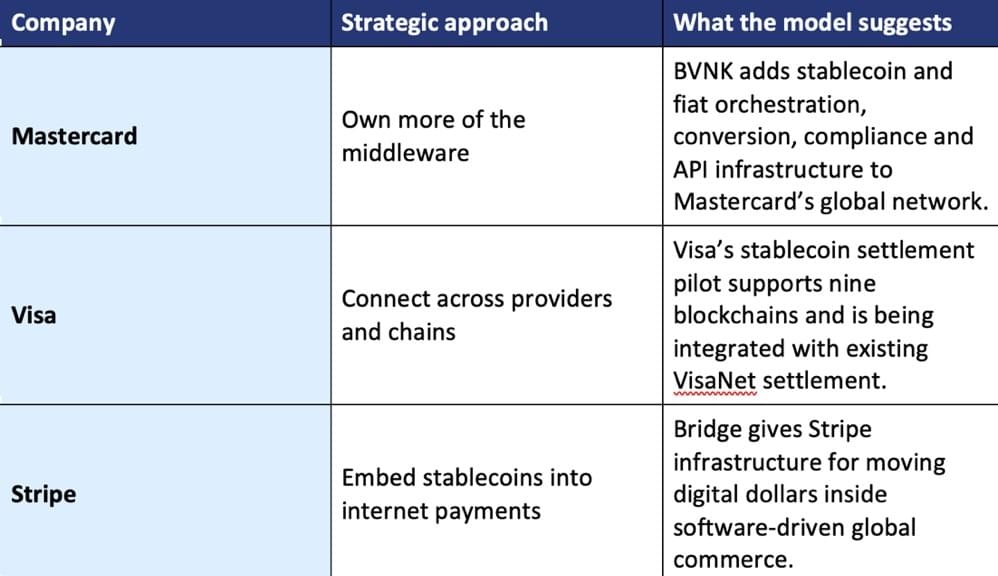
Stablecoins were meant to weaken incumbent payment networks: Mastercard’s BVNK acquisition suggests incumbents may instead absorb the disruption by owning infrastructure connecting new forms of money to traditional finance. On 3 August 2026, Mastercard completed its acquisition of fintech company, BVNK, after agreeing in March to pay up to $1.8 billion, including $300 million in contingent payments. Mastercard described the logic in broad terms. In a “multi-money world” of fiat currencies, stablecoins, tokenised deposits and other digital assets, the next payments paradigm will be determined by how effectively those forms of value connect. That is different from simply enabling customers to “pay with crypto”. BVNK provides infrastructure that allows businesses to hold, move, manage and convert fiat and digital currencies whilst abstracting away wallets, blockchain connectivity, liquidity providers, banking relationships and much of the compliance complexity. Mastercard already connects financial institutions, merchants and consumers globally, therefore, combining the two creates something possibly more valuable than another payment rail: a routing layer between many rails.
Potentially, the middleware becomes the toll road. Payment economics are usually discussed in terms of the visible rail: cards, bank transfers, stablecoins or tokenised deposits. Yet in a multi-rail economy, strategic value may migrate to the layer deciding which rail should be used, how value is converted, which counterparty can be trusted, how sanctions and compliance checks are applied, and when settlement occurs. For example, if a company in London pays a supplier in Singapore, then its treasury department should not need to decide whether the transaction travels through a correspondent bank, regulated stablecoin, tokenised deposit or card-linked mechanism. Infrastructure can increasingly make that choice according to cost, liquidity, speed, regulation and risk. Mastercard can therefore remain economically relevant even if the underlying rail changes. Card interchange may face pressure from low-cost on-chain transfers but revenue can migrate towards FX, liquidity management, orchestration, identity, compliance, API access and settlement assurance. Blockchain-powered payments may not kill payment networks - it may simply change what they charge for.
Three strategies are emerging
Mastercard is not alone. Visa reported in April 2026 that its stablecoin settlement pilot had reached a $7 billion annualised run rate and expanded to nine blockchains. Moreover, Stripe had completed its acquisition of Bridge in February 2025, integrating stablecoin infrastructure into its internet-native payments stack. The strategic direction is similar, but the models differ. Hence, the contest is no longer “crypto versus cards” - it is becoming a race between card networks, banks, fintechs and blockchain-native firms to own the interface through which different forms of money become usable.
Source: Teamblockchain
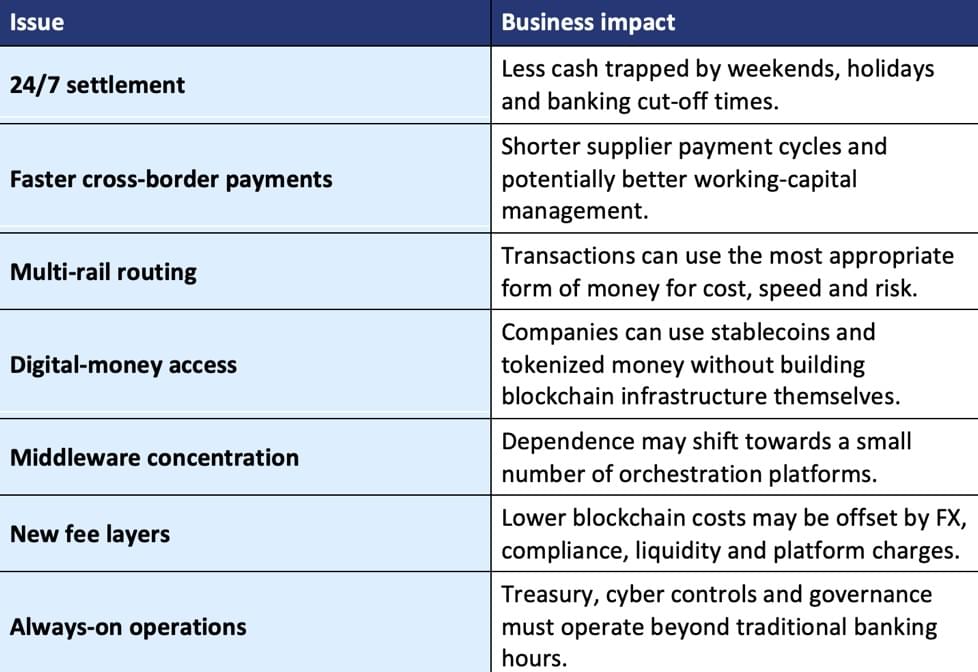
The uncomfortable question, however, is whether technology designed to remove intermediaries instead creates a new class of super-intermediary. An on-chain stablecoin transfer can be cheaper than a traditional cross-border card payment, but businesses should not assume every saving will be passed through; the fee stack can simply be reconstructed elsewhere. A merchant may pay less for movement of the token but still pay for FX conversion, liquidity, regulatory screening, fraud protection, identity, wallet services and guaranteed settlement, and those services are valuable. The strategic issue is who captures their economics, which is why BVNK matters. Mastercard does not need every transaction to remain on a card rail. It needs to remain relevant to the movement of value in global and domestic payments. For businesses, that could still be good news. Mastercard announced in June this year that it plans to expand settlement to include intraday, weekend and holiday options, using both fiat and regulated stablecoins. Faster settlement can therefore reduce money sitting idle between authorisation and final receipt, improve liquidity management and make corporate treasury less dependent on banking cut-off times. The more powerful proposition is abstraction: a manufacturer, retailer or professional-services firm should not need an internal blockchain team simply to benefit from digital settlement. If complexity is hidden behind familiar APIs, then enterprise adoption becomes much easier.
What businesses could gain, and what they should question
Source: Teamblockchain
AI agents could make middleware strategic infrastructure
Mastercard launched Agent Pay for Machines in June 2026 to support payments made by AI agents and connected machines. It envisages autonomous systems conducting continuous, high-velocity chains of transactions, including payments worth fractions of a cent; BVNK was named among the initial ecosystem participants. Conventional payment interfaces were designed for people. Humans can type card details, pass 3D Secure checks, log into bank accounts and tolerate checkout screens but an AI agent buying an API call, purchasing compute or negotiating with another machine needs machine-readable identity, spending permissions, instant authorisation and programmable settlement. Coinbase’s x402 protocol illustrates the direction - it revives the HTTP 402 “payment required” status code so a server can quote a price, and an AI agent can automatically make a stablecoin payment before receiving a digital service. No conventional account or human checkout is required. Now imagine BVNK-style infrastructure behind that interaction. An agent could receive a spending mandate in sterling, pay a supplier in USDC, route across a blockchain, settle instantly and allow the recipient to convert back into US dollars or bank money (the user may never know which rail was used). The next wave of payment volume may come less from new cardholders than from billions of software agents making huge numbers of small transactions.
This is no longer merely a theoretical payment protocol. By June 2026, Coinbase stated that x402 had processed more than 160 million agentic payments over the previous year. Coinbase also reported processing nearly $1 trillion of stablecoin movement annually. The numbers matter because they suggest two previously separate trends are beginning to converge: stablecoins provide machine-readable money whilst AI agents provide machine-driven demand for it. If software increasingly purchases data, compute, APIs and other digital services autonomously, then payment infrastructure may have to accommodate transaction volumes and values very different from those generated by humans. Furthermore, Coinbase announced that publishers and API providers using AWS CloudFront and Web Application Firewall could enable x402 payments from AI agents through their existing AWS configuration (Coinbase estimates that roughly a quarter of the internet uses those AWS services). The significance is economic rather than technological: websites that currently block automated traffic, or allow AI systems to consume information without payment, could instead turn machines into customers. An agent could discover data, receive a machine-readable price, make a stablecoin micropayment and consume the service without opening an account or entering card details. Consequently, stablecoins become not merely another currency but a potential settlement mechanism for a machine-to-machine economy.
Moreover, the payment networks are already acknowledging that moving money is only part of the problem. Visa has introduced an Agentic Registry and Agent Scoring, capabilities intended to help identify legitimate agents and assess their behaviour which points towards a potentially valuable new layer of payments infrastructure: ‘know your agent’ alongside ‘know your customer’. Before an autonomous system is allowed to spend, somebody needs to establish who controls it, what authority it has, which counterparties it may engage with and the limits of its mandate. The economic opportunity may therefore migrate beyond processing payments towards selling the identity, permissions, fraud controls and audit trail that make machine payments trustworthy. Machine commerce also creates harder questions, including:
· who verifies the agent?
· how much may it spend?
· who is liable when it pays the wrong counterparty?
· what happens when a smart contract executes exactly as coded but contrary to commercial intent?
The emerging contest may therefore be less about which stablecoin wins than which infrastructure becomes the operating system for money. Mastercard is assembling routing and stablecoin infrastructure through BVNK; Visa is building multi-chain settlement, agent identity and risk controls; Stripe is embedding stablecoins into software; Coinbase is turning HTTP itself into a payment interface; and AWS can now expose that capability to a substantial portion of the web. The underlying asset may be USDC, a bank deposit, fiat currency or, eventually, another tokenised instrument. What matters economically is who authenticates the machine, interprets its mandate, chooses the rail, performs compliance checks, provides liquidity, converts the currency and confirms settlement. Regulators should watch this paradox: cheaper infrastructure can make control points more valuable. Mastercard’s acquisition of BVNK may prove important, not because it validates stablecoins but because it reveals where the next payments battle will be fought. The winner may not issue the dominant stablecoin, own the fastest blockchain or operate the largest card network. It may be the company sitting invisibly between them all, deciding how money is authenticated, converted, routed and settled.
In a world where humans, companies and AI agents transact continuously, owning the middleware may mean owning the economics of money movement itself.
This article first appeared in Digital Bytes (22nd of September, 2026), a weekly newsletter by Jonny Fry of Team Blockchain.
How will tokenisation reshape finance in practice?